
The History and Strategy of Backgammon: From Ancient Persia to Today
The History and Strategy of Backgammon: From Ancient Persia to Today
Backgammon is one of the oldest board games for two players.
The playing pieces are moved according to the roll of dice, and a player wins by removing all of their pieces from the board before their opponent.
Backgammon is a member of the tables family, one of the oldest classes of board games in the world.
Ancient Origins and Takht-e-Nard
In Persian, the game of backgammon is known as takht-e-nard.
Its exact origin is unclear, but it is thought to have first been played in Mesopotamia and Sumer about 5,000 years ago.
The modern game seems to have developed directly from the Persians.
According to H.G. Raverty, in an article entitled "The Invention of Chess and Backgammon": "Ard-Shir Babakan, son of Babak of the Sassanian dynasty of Iran-Zamin or the ancient Persian empire, invented it. The game was also sometimes called Nard-i-Shir after him." (Journal of the Asiatic Society of Bengal, ca. 1886)
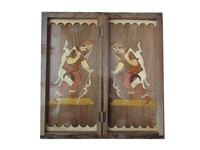
Strategy and Gameplay
Backgammon involves a combination of strategy and luck (from rolling dice).
While the dice may determine the outcome of a single game, over a series of many games, the better player will accumulate the better record.
Thus, records of matches between players are good indicators of relative skill.
With each roll of the dice, players must choose from numerous options for moving their checkers and anticipate possible counter-moves by the opponent.
In variants that originate from early 20th century New York, players may raise the stakes during the game.
There is an established repertoire of common tactics and occurrences.
Explore exquisite handcrafted backgammon and chess sets online at Craftihouse.
Recent Posts
-
Retirement Gift Ideas in Dubai | Craftihouse
Retirement Gift Ideas in Dubai If you're looking for a retirement gift in Dubai, there are plenty of …25th Sep 2026 -
Custom Portrait Painting in Dubai — The Ultimate Handmade Gift for 2026 | Craftihouse
Custom Portrait Painting in Dubai — The Ultimate Handmade Gift for 2026 A photograph captures a mome …6th May 2026 -
Custom Arabic Calligraphy Name Art on Paper — The Timeless Handmade Gift in Dubai 2026
Custom Arabic Calligraphy Name Art on Paper — The Timeless Handmade Gift in Dubai 2026 In an era of …6th May 2026